Hemingway six word stories are one of the most famous examples of micro-fiction. In just six words, a complete story can unfold — suggesting emotion, character, and conflict without explanation.
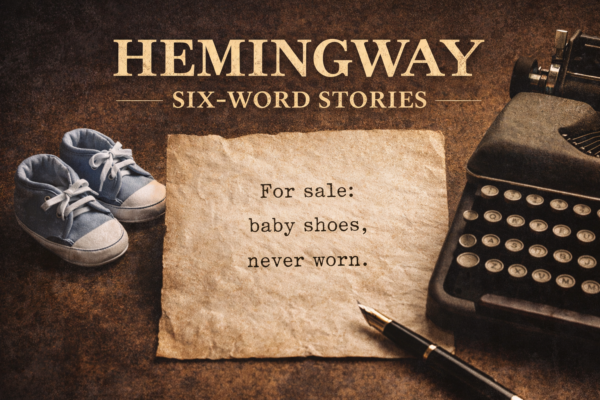
The most famous example, often attributed to Ernest Hemingway, is:
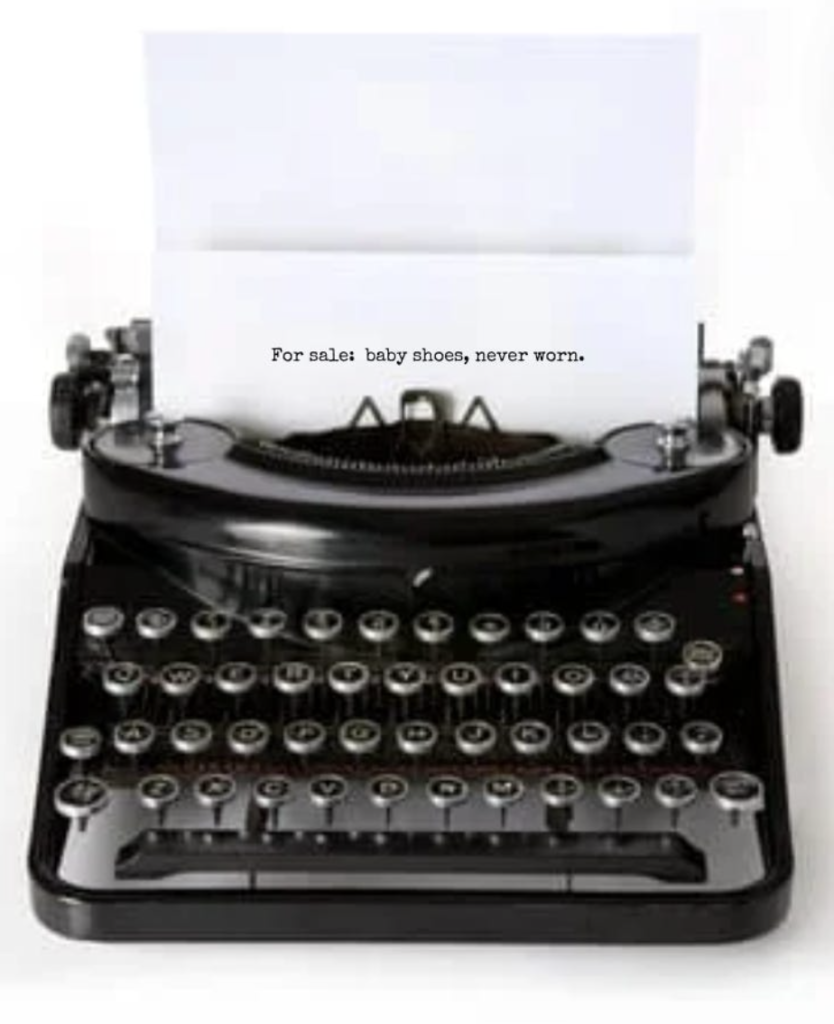
For sale: baby shoes, never worn.
Whether or not Hemingway actually wrote it, this six word story has inspired millions of writers to explore the power of extreme brevity.
This story suggests loss, grief, and untold tragedy — all without explicitly stating what happened. The emotional weight comes from what is left unsaid.
Contents
- What Is a Hemingway Six Word Story?
- Who Was Ernest Hemingway?
- Hemingway’s Six Word Story in Popular Culture
- How Six Word Stories Evolved and Thrive Today
- Can a Story Be Shorter Than Six Words?
- Other Forms of Microfiction
- More Examples of Six Word Stories
- How to Write Hemingway Six Word Stories
- Different Types of Six Word Stories
- Six Word Stories vs Traditional Short Story
- Why Are Hemingway Six Word Stories So Popular?
- FAQ
What Is a Hemingway Six Word Story?
A six word story is a complete narrative told in exactly six words. It typically implies a larger story beneath the surface, forcing the reader to fill in the gaps.
- Exactly six words
- A clear or implied narrative
- Emotional or surprising impact
- No unnecessary filler
This minimalist storytelling style reflects Hemingway’s famous “iceberg theory” — where most meaning lies beneath the surface.
Who Was Ernest Hemingway?
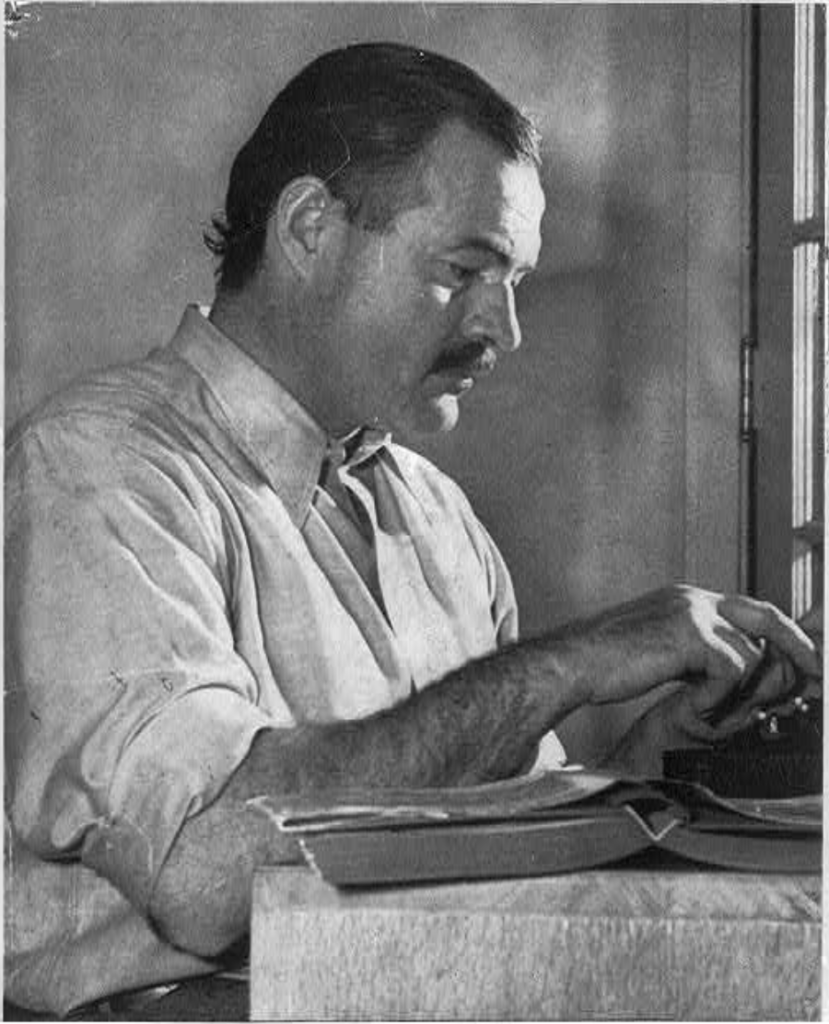
Ernest Hemingway was one of the most influential writers of the 20th century, known for his clear, direct prose and his ability to say more with less.
Born in 1899 in the United States, Hemingway worked as a journalist before becoming a novelist and short story writer. His experiences covering wars and living abroad shaped much of his writing, giving it a sense of realism, restraint, and emotional depth.
He is best known for classic works such as The Old Man and the Sea, A Farewell to Arms, and For Whom the Bell Tolls. His writing style avoided unnecessary detail, focusing instead on simple language and powerful subtext.
This approach became known as the “iceberg theory” — the idea that the deeper meaning of a story should not be obvious on the surface, but felt beneath it.
Hemingway won the Nobel Prize in Literature in 1954, cementing his reputation as one of the greatest writers of his generation.
The famous six word story attributed to him perfectly reflects his philosophy: a handful of words can carry the weight of an entire story.
Hemingway’s Six Word Story in Popular Culture
The famous six word story — “For sale: baby shoes, never worn.” — has taken on a life far beyond literature. Whether or not Ernest Hemingway actually wrote it, the story has become a cultural shorthand for powerful, minimalist storytelling.
It is often referenced in film, television, writing workshops, and even marketing as an example of how a few carefully chosen words can carry enormous emotional weight.
Doctor Who and the Power of Six Words
One of the most well-known modern uses of the Hemingway Six Word Stories concept appears in Doctor Who, where the idea of a short, perfectly crafted message carries huge significance.
In the episode Blink, a message is delivered across time using a limited number of words, reinforcing the idea that brevity can be both practical and powerful. The show returns to this idea again and again, often suggesting that a small number of words — sometimes even fewer than 6 — can change everything.
Fans of the show often connect this concept to Hemingway’s six word story, seeing both as examples of how storytelling can rely on implication rather than explanation.
Across Media and the Internet
The Hemingway Six Word Stories format has become especially popular online. Social media platforms, writing communities, and competitions regularly challenge users to tell complete stories in just six words.
- Viral writing challenges and hashtags
- Creative writing classrooms and workshops
- Advertising campaigns using ultra-short storytelling
- Books and collections dedicated entirely to six word narratives
Its appeal lies in its simplicity: anyone can try it, but mastering it is surprisingly difficult.
Today, the Hemingway six word story is less about authorship and more about influence. It has become a global creative exercise — proof that even the smallest stories can leave a lasting impression.
How Six Word Stories Evolved and Thrive Today
What began as a piece of literary folklore has grown into a global creative movement. The six word story has evolved far beyond its origins, finding new life across the internet, in publishing, and in modern writing communities.
Its survival comes down to one simple truth: the format fits perfectly with how people read and share content today. Short, impactful, and easy to engage with, six word stories thrive in a world of limited attention and constant scrolling.
Hemingway Six Word Stories Online
The rise of online communities has played a huge role in keeping the form alive. Platforms like Reddit’s r/sixwordstories have attracted millions of readers and writers, sharing everything from dark humor to emotional micro-fiction.
These spaces turn six word storytelling into a daily creative exercise, where anyone can participate, experiment, and refine their craft.
The Rise of Six Word Memoirs
The format also found a new audience through six word memoirs — personal stories told in just six words. Popularised by books like Not Quite What I Was Planning, this variation invites people to distill their lives into a single, revealing sentence.
Six word memoirs shifted the form from purely fictional storytelling into something more personal, reflective, and widely accessible.
A Modern Creative Movement
Today, Hemingway Six Word Stories continue to grow through dedicated platforms, competitions, and collections. Writers around the world are experimenting with tone, genre, and structure — from horror and comedy to romance and memoir.
One of the most active contributors to the form is Doug Weller, whose Six Word Wonder project has produced thousands of original six word stories and attracted tens of thousands of submissions from writers globally.
Through curated collections, themed categories, and ongoing competitions, the project demonstrates just how flexible and enduring the format has become.
Explore the full collection in The Wonder List or try writing your own.
More than a century after its supposed origin, the six word story is no longer just a literary curiosity. It is a living form — constantly evolving, endlessly creative, and still proving that a few words can say everything.
Can a Story Be Shorter Than Six Words?
If six words can tell a complete story, the natural question is: can you go even shorter?
The answer is yes — but it becomes significantly harder.
Can a 3 Word Story Work like a Hemingway?
A three word story could work, but only under the right conditions. With so few words, there is almost no room for structure, so the meaning has to come from implication, context, or contrast.
- “She never returned.”
- “Wrong door. Screaming.”
- “We both lied.”
- “Baby shoes. Unused.”
Each of these hints at a larger narrative, but relies heavily on the reader to fill in the gaps.
What About Two Words… or One?
Stories can be reduced even further:
- Two words: “Jesus wept.”
- One word: “Alone.”
At this point, the line between a “story” and a “feeling” begins to blur. The fewer the words, the more the reader must supply meaning themselves.
Why Six Words Became the Sweet Spot
Six words sit in a unique middle ground. These microfictions are short enough to be striking, but long enough to suggest:
- A character or subject
- A situation or action
- An implied outcome or twist
This is why the Hemingway six word story feels complete in a way that shorter forms often don’t. It gives just enough structure for a full narrative to emerge, while still relying on the reader’s imagination.
Shorter stories can work — but six words may be the shortest length where storytelling consistently feels whole rather than fragmented.
Other Forms of Microfiction (And Where Six Word Stories Fit)
Six word stories are part of a wider family of microfiction — extremely short pieces of storytelling that rely on brevity, implication, and precision.
While Hemingway Six Word Stories are the most famous example, writers have been experimenting with ultra-short storytelling for decades across many different formats.
Flash Fiction
Flash fiction typically ranges from around 300 to 1,000 words. It still tells a complete story, but in a compressed form compared to traditional short fiction.
Think of it as a bridge between full short stories and microfiction.
Sudden Fiction
Sudden fiction is even shorter, often under 750 words. The focus is on a single moment or turning point rather than a fully developed narrative arc.
Drabble
A drabble is a story told in exactly 100 words. The fixed length forces writers to be precise while still allowing for character, setting, and plot.
Dribble
A dribble is even shorter — exactly 50 words. It strips storytelling down further, but still allows more room than a six word story.
Twitter Fiction
With the rise of social media, Twitter fiction (now often called social media microfiction) became popular. Stories are written within character limits, encouraging tight, punchy storytelling.
Hint Fiction
Hint fiction is extremely short storytelling, usually capped at 25 words or fewer. Like six word stories, it relies heavily on suggestion and subtext.
Hemingway Six Word Stories: The Extreme Edge
Within this spectrum, six word stories sit at the absolute extreme. They allow almost no room for explanation, forcing every word to carry meaning.
Unlike longer microfiction forms, six word stories often:
- Skip traditional structure entirely
- Rely on implication rather than description
- Create impact through contrast or surprise
- Invite the reader to complete the story
This is what makes them unique. Where flash fiction tells a short story, a six word story suggests a story that exists beyond the page.
In that sense, Hemingway Six Word Stories aren’t just part of microfiction — it represents its most distilled form.
More Examples of Six Word Stories
- He never returned. Still waiting here.
- She waved goodbye. The gallows creaked.
- Opened the letter. Everything changed instantly.
- We won the war. Nobody celebrated.
- They laughed. I wasn’t joking anymore.
- Lights flickered. Something moved behind me.
Explore hundreds more in the Six Word Wonder collection.
How to Write Hemingway Six Word Stories
- Start with a bigger story — then strip it down.
- Focus on implication rather than explanation.
- Use contrast or surprise to create impact.
- Make every word earn its place.
- Leave space for the reader to interpret.
The best six word stories feel like the tip of something much larger.
Different Types of Hemingway Six Word Stories
There are many different kinds on story, poem, or joke that can fit the 6 word story format. Play around with these.
- Wordplay Six Word Stories
- Alliterative Six Word Stories
- Dark Six Word Stories
- Famous Six Word Stories
- For Sale Six Word Stories
- Funny Six Word Stories
- Horror Six Word Stories
- Quotation Six Word Stories
- Reddit Six Word Stories
- Romantic Six Word Stories
- Sad Six Word Stories
- Scary Six Word Stories
- Short Six Word Stories
- Six Word Memoirs
- Strange Six Word Stories
- Surprise Six Word Stories
- Twist Six Word Stories
Hemingway Six Word Stories vs Traditional Short Story
Traditional short stories build character, setting, and plot over pages. Six word stories compress all of that into a single line.
Instead of telling the story, they trigger the story in the reader’s mind.
Why Are Hemingway Six Word Stories So Popular?
- They are quick to read and share
- Perfect for social media
- Encourage creativity and constraint
- Highly memorable
This makes them ideal for modern audiences with shorter attention spans.
Join thousands of writers crafting powerful stories in just six words.
Frequently Asked Questions about Hemingway Six Word Stories
Did Hemingway really write the six word story?
There is no definitive proof. The story is widely attributed to Ernest Hemingway, but the origin is debated.
What is the meaning of the six word story?
It demonstrates how powerful implication can be. The story suggests tragedy without explicitly stating it.
Can anyone write Hemingway six word stories?
Yes. Anyone can write one — but writing a great one takes precision, creativity, and restraint.