Take some time to enjoy Hemingway’s Typewriter – Every click of the “Return” key pulls a fresh six word story from our archive. What will you discover?
Hemingway’s Typewriter – The Six Word Story Archive
SYNCHRONIZING MANUSCRIPT…
Pull a new story from the database
The Six Word Story Archive
Welcome to Hemingway’s Typewriter. The Six Word Story Archive is a curated collection of over 5,000 entries, proving that the smallest windows can offer the widest views. Inspired by the legendary challenge to “tell a story in six words,” this living manuscript captures the spectrum of human experience—from the tragic and the noir to the hopeful and the absurd.
This isn’t just a list; it is an exploration of the power of restraint. In a world of noise, we invite you to find the impact in the silence between six carefully chosen words.
Why the Six Word Story Archive Exists
- Literary Precision: To showcase how narrative weight can be stripped of filler.
- A Living Record: A massive, searchable repository of contributions from writers across the globe.
- The Hemingway Legacy: Honoring the tradition of minimalist fiction through a tactile, mid-century aesthetic.
“Short enough to read in a breath; long enough to stay with you for a lifetime.”
Explore More 6 Word Stories
Pick a mood. Follow your curiosity. Every category hides a different kind of story.
Learn more about Six Word Wonders
Discover the books, contests, prompts, and tiny stories behind Doug Weller’s Six Word Wonder project.
✒️ Six Word Story Archive: FAQ
What exactly is a six word story?
A six word story is an entire narrative told using exactly six words. It is the most extreme form of “flash fiction.” The goal isn’t just to write a sentence, but to imply a much larger back-story, conflict, or emotional resolution through the clever use of brevity.
Did Ernest Hemingway really start this?
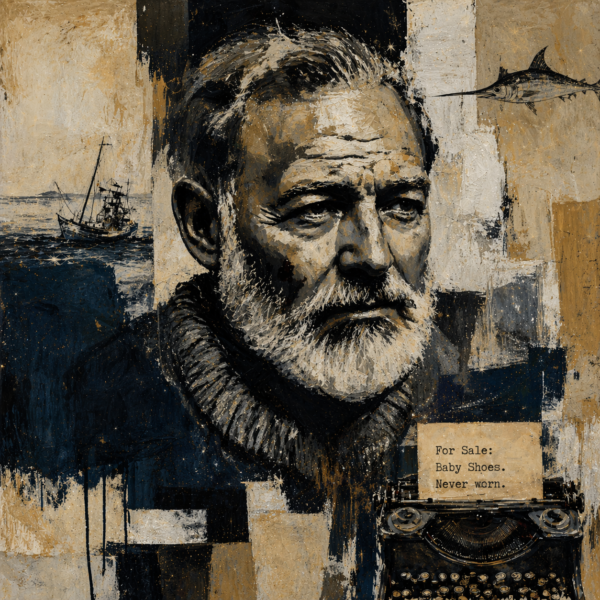
Legend has it that Hemingway was challenged in a bar to write a full story in only six words. He allegedly scribbled, “For sale: baby shoes, never worn” on a napkin and won the bet. While historians debate if he actually wrote it, the “Baby Shoes” story remains the gold standard of the genre, proving that what is left out is often more powerful than what is put in.
Why limit it to only six words?
The limitation is a creative “stress test.” By removing the ability to use flowery descriptions or long setups, a writer is forced to choose only the most “expensive” words—those that carry the most weight. It turns storytelling into a puzzle where the reader’s imagination does half the work.
How do you read the six word story archive?
Slowly. Unlike a novel where you rush to the next page, a six word story is meant to be “unpacked.” Because they are so short, you should look for the hidden meaning. Why are the shoes “never worn”? What happened to the “hero” who didn’t stay? The story happens in the gap between the words.
Where did this Six Word Story Archive come from?
These are entries from previous Six Word Wonder contests. We always credit the writer. There are so many stories – read them at your own risk.
⌨️ The Hemingway Typewriter: FAQ
What is the “Hemingway Typewriter” on this site?
The Hemingway Typewriter is our custom-built digital archive engine. Instead of a standard list or a modern database, we’ve designed a tactile interface that mimics the experience of a mid-century manual typewriter. It “types” stories from our archive letter-by-letter, forcing a rhythmic, focused pace of reading.
Where do these stories come from?
The stories are pulled from a massive, live database of over 5,000 unique entries. These include classic examples of the genre, contest winners, and curated submissions from writers around the world. Every time you hit the “Return Key,” the machine synchronizes with our master ledger to bring you a new piece of fiction.
Why does it type out so slowly?
This is intentional. Modern internet browsing is often too fast for deep reflection. The typewriter effect mimics the “hammer and ink” of a real machine, encouraging you to digest each word as it appears. It’s a “slow-reading” experience designed to give the prose the respect it deserves.