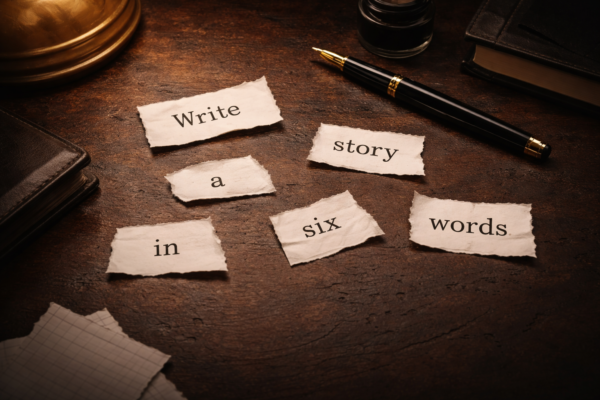
Six Word Stories Contest
Can you break a heart, land a joke, start a war, or end a marriage in just six words? Welcome to the Six Word Wonder Six Word Stories Contest, a creative challenge for writers who love precision, surprise, and the thrill of making a tiny story hit hard.
This is a free six word stories contest for writers, dreamers, poets, jokers, lurkers, and anyone who has ever felt that one good line can do more than a page of explanation. If you think six words can carry a world, this is your kind of contest.
The Contest at a Glance
- What: A six word stories contest for original work
- Cost: Free to enter
- Prize: $100 cash prize
- Format: Exactly six words
- Language: English
What Makes This Six Word Stories Contest Different?
Some writing contests want polish. Some want prestige. This one wants impact. We are looking for stories that do something in six words. Make us laugh. Make us flinch. Make us wonder what happened before, or what happens next. We love stories that leave an aftertaste.
A great six-word story can feel like a punchline, a confession, a horror scene, a memory, a breakup, a eulogy, or the first line of a much bigger universe. The point is not just brevity. The point is electricity.
If you need inspiration, browse six word story examples, try these six word prompts, or explore the wider Wonder List.
How to Enter
Entering the Six Word Wonder Six Word Stories Contest is simple. Writing a brilliant entry is the difficult bit.
- Write an original story in exactly six words.
- Check the count carefully. Six means six.
- Make sure the story is yours and not AI-generated.
- Submit it using the contest form.
- If allowed, send in more than one entry and give yourself more chances to land the perfect line.
That is it. No padding. No waffle. No room to hide. Which is exactly why the form is so addictive.
What We’re Looking For
The best entries in a six word stories contest usually have one or more of these qualities:
- A twist: something shifts in the final word or phrase
- A sting: emotional impact, whether funny, sad, dark, or sweet
- A spark: a strong image, idea, or contradiction
- Control: every word feels chosen, not accidental
- Echo: the story lingers after it ends
We do not care whether your story is comic, tragic, strange, romantic, weird, bleak, playful, or impossible to categorise. We care whether it works.
A Few Six Word Stories Contest Examples
Not to copy. Just to remind you what six words can do.
She smiled. The trap snapped shut.
Cannibal dated vegan. Developed nut allergy.
He finally rose. “Sorry, wrong funeral.”
Monsters exist. They tuck me in.
Want more? Explore famous six word stories, short six word stories, dark six word stories, or six word memoirs.
Why Enter?
Because constraints can be liberating. Because six words can force you to be sharper, stranger, funnier, and braver. Because writing tiny stories is one of the purest creative pleasures there is. And because winning money for six words is objectively delightful.
- Challenge your creative instincts
- Write something genuinely memorable
- Enter a contest that respects imagination over waffle
- Compete for a cash prize
- See your work featured or published
- Join the wider world of Six Word Wonder
For the live entry form and full current contest details, visit the main Six Word Wonder contest page.
Frequently Asked Questions About the Six Word Stories Contest
If you are thinking about entering a six word stories contest, you probably have a few questions first. What counts as a story? Does it really have to be six words? Can it be funny, strange, sad, or dark? What are the judges looking for? This FAQ covers the most common questions about the Six Word Wonder Six Word Stories Contest and should help you feel more confident before you submit your entry.
What is a six word stories contest?
A six word stories contest is a creative writing competition in which every entry must tell a story using exactly six words. That may sound tiny, but that is the whole challenge. A great six-word story does not just describe something. It creates movement, implication, surprise, emotion, or tension in an extremely compressed space.
The best entries in a six word stories contest can feel like full little worlds. Some are funny. Some are heartbreaking. Some are creepy. Some are romantic. Some land like a punchline, while others feel like the aftermath of a life. What matters is not the number of words alone, but what those words manage to do.
That is why six-word contests are so appealing. They are open to almost anyone, yet surprisingly hard to master. The form is simple to understand, but difficult to do brilliantly.
Do the stories really have to be exactly six words?
Yes. In a six word stories contest, six means six. Not five. Not seven. Not “roughly six.” The exact word count is the defining rule of the form, and it is what makes the contest both strict and exciting. The constraint is not there to be annoying. It is there to sharpen the writing.
If you go over the limit, your story may be disqualified. If you fall short, it may not count as a valid entry either. So before you submit, it is worth checking your wording carefully. Read the line aloud. Count each word slowly. Then count again. Often the strongest six-word stories improve during this process, because the need to fit the form pushes you towards cleaner and more memorable language.
One of the pleasures of the form is that every word has to earn its place. That is part of what makes a six word story contest so satisfying for writers who enjoy precision.
What counts as a story in a six word stories contest?
That is one of the most interesting questions in any six word stories contest. A story does not need a beginning, middle, and end in the traditional sense. In six words, you are usually working with implication rather than full explanation. A strong entry hints at something larger than itself. It suggests a before and after. It creates a shift, a tension, an image, or an emotional charge that makes the reader feel there is more behind the line.
For example, a six-word story might imply a breakup, a betrayal, a death, a joke, a ghost, a misunderstanding, or a triumph. It does not need to spell everything out. In fact, many of the best entries leave room for the reader to participate. They invite imagination rather than closing every gap.
In other words, what counts as a story is not sheer information. It is the sense that something has happened, or is about to happen, or has been emotionally understood in a way that feels alive.
Can my entry be funny, dark, weird, romantic, or sad?
Absolutely. One of the great joys of a six word stories contest is that the form can hold almost any tone. A six-word story can be comic, surreal, tragic, mysterious, wistful, frightening, ironic, poetic, or absurd. There is no single “correct” emotional register for the contest.
Funny stories can work beautifully because the short form suits punchlines. Dark stories can also be very powerful because they hit quickly and leave the reader to imagine the rest. Romantic stories, strange stories, sad stories, and tiny philosophical stories can all succeed too. The key thing is not genre but effect. Does the story land? Does it surprise, move, haunt, amuse, or linger?
If you enjoy different styles, it can be worth writing several entries in completely different moods. One may be playful. One may be heartbreaking. One may be strange. A six word stories contest rewards experimentation.
What makes a strong entry in a six word stories contest?
A strong entry in a six word stories contest usually does at least one thing very well. It may contain a twist. It may create an unforgettable image. It may suggest a whole life in miniature. It may use rhythm or contrast cleverly. It may be emotionally sharp. It may simply feel inevitable, as if no other six words would do.
What weakens an entry is often vagueness. If the story feels generic, over-explained, or merely like a statement rather than a story, it may not stand out. Strong six-word stories tend to feel charged. They create a sense of compression and release. They often leave a little spark in the reader’s mind.
Clarity also matters. A story can be strange or subtle, but it should not feel clumsy. In such a short form, even one weak word can reduce the force of the whole entry. That is why revision matters so much in a six word stories contest.
How do judges usually decide which six-word stories are best?
Every contest has its own taste and standards, but in general, judges in a six word stories contest are looking for originality, precision, and impact. They want a line that feels deliberate and alive. A story that sounds familiar or predictable may be neat, but it is less likely to be memorable. By contrast, an entry that surprises the reader while still feeling clean and controlled has a much better chance of standing out.
Judges also tend to notice whether the six words genuinely work together as a story. A clever phrase is not always enough. A dramatic setup is not always enough. The most successful entries often feel both compressed and complete. They leave the reader with a small shock of recognition, emotion, or admiration.
Another useful thing to remember is that judges read many entries. That means freshness matters. If your line feels too close to a cliché or a familiar six-word pattern, it may not rise above the crowd. Distinctiveness counts.
Can I submit more than one entry?
Yes, in most cases a six word stories contest allows more than one entry, up to the current contest limit. Check the live rules for the exact number permitted. If multiple entries are allowed, that is usually a good opportunity rather than a trap. Six-word writing benefits from variety. Your first idea may be good, but your third or fifth idea may be much better.
Submitting multiple entries also lets you explore different tones and strategies. You might send one funny line, one dark line, one emotionally revealing line, and one that relies on a twist. That gives you more chances to discover what works best, both for you and for the contest.
That said, more is not always better if the entries are weak. It is usually worth sending fewer stories that feel truly finished rather than many that feel rushed.
Do I need to be an experienced writer to enter?
Not at all. One reason the six word stories contest format is so appealing is that it is accessible. You do not need to have written a novel, studied creative writing, or published short stories before. You just need one idea and the willingness to keep refining it until it clicks.
In fact, beginners often enjoy six-word writing because the small scale makes the challenge feel playful rather than intimidating. Experienced writers like it for a different reason: the discipline of cutting and controlling every word. So whether you are brand new or highly practised, the contest can be rewarding.
What matters most is not your level of experience. It is whether your six words create something memorable.
How do I come up with an idea for a six-word story?
There are many ways to start. Some writers begin with an emotion. Others begin with an image, a secret, a contradiction, a joke, or a moment of loss. In a six word stories contest, you do not need a giant plot. You need a small charged idea.
You might ask yourself questions like these: What is something I wish I had said? What is something strange that happened to me? What makes me laugh? What frightens me? What tiny scene suggests a much bigger story? You can also start with opposites, such as joy and grief, love and resentment, innocence and danger, success and emptiness.
If you want a prompt-based approach, the Six Word Prompts page is a good place to start. Prompts can help loosen your thinking and lead you towards stories you might not have found directly.
Should I write one perfect entry or several different ones?
Usually, several. In a six word stories contest, the first idea is not always the strongest. Often the best results come after experimentation. You might write ten quick drafts and only one will truly come alive. That is normal. Because the form is short, you can afford to explore.
Try writing a few very different entries rather than small variations of the same one. Write one that aims for a twist. Write one that aims for emotional truth. Write one that is comic. Write one that is dark. This not only gives you options, it helps you understand what kind of six-word writing you do best.
The short form can create the illusion that writing is instant. In reality, many strong six-word stories emerge from drafting, comparison, and ruthless cutting.
Can I use a line I posted elsewhere before?
That depends on the contest rules, so check the current terms carefully. Many writing contests prefer unpublished or previously unsubmitted work, while others are more flexible. For a six word stories contest, originality is always important, and it is usually safest to submit something fresh that you are happy to stand behind as your own.
Even if a contest does not explicitly ban previously shared lines, it may still be wiser to enter with a new story. That way the piece is shaped for this exact competition, and you avoid any uncertainty about prior publication or overlap.
Are AI-generated entries allowed?
No. In this six word stories contest, AI-generated entries are not allowed. The point of the contest is human imagination, judgment, wit, feeling, and craft. A six-word story may be tiny, but it still reflects creative choices, and those choices are part of what the contest is celebrating.
If you use tools to brainstorm privately, be very careful, because it can become difficult to draw a clear line. The safest and strongest route is to write your own entry from scratch. After all, the satisfaction of this form comes from making six words work through your own instinct and revision.
For many writers, that creative pressure is exactly what makes the contest worthwhile.
What kinds of mistakes weaken entries in a six word stories contest?
One common problem is over-explaining. In a six word stories contest, you do not have room to explain everything, so trying to do so usually makes the story feel flat. Another common weakness is vagueness. If the line could apply to almost anything, it may not leave much impression.
Other weak spots include predictable twists, tired phrasing, fake profundity, and stories that feel more like slogans than stories. Sometimes an entry has a decent idea but the wrong wording. A single stronger verb, noun, or final word can transform the whole line.
There is also the simple technical mistake of miscounting. It sounds minor, but it matters. If the contest says six words, then accuracy is part of the craft.
Is it better to write a story with a twist?
Not always, though twists can work very well in a six word stories contest. A twist is one effective strategy, but it is not the only one. Some of the strongest six-word stories rely on emotional truth rather than surprise. Others use image, rhythm, or implication. A quiet story can be just as powerful as a twisty one if it lands cleanly and leaves a mark.
That said, because the form is so short, a change in meaning at the end can have a strong effect. If you can make the final word or phrase shift the whole line without feeling forced, that can be very memorable. The key is to avoid building a story that feels like a gimmick. Surprise should serve the story, not replace it.
Can six-word stories be poetic as well as narrative?
Yes. A six word stories contest may be story-focused, but many strong entries also carry poetic qualities. They may use rhythm, contrast, compression, image, or ambiguity in ways that feel lyrical. The border between tiny story and tiny poem can be beautifully thin.
What matters is that the line still feels alive as a story, or at least as a moment with narrative pressure. If the words are beautiful but static, the entry may feel more like a caption than a story. But if the language is poetic and still creates movement or implication, it can be a powerful combination.
This is one reason the form appeals to so many different kinds of writers. It welcomes narrative instinct, poetic compression, comic timing, and emotional honesty all at once.
What can I win in this six word stories contest?
The winner of the Six Word Wonder Six Word Stories Contest receives the current advertised cash prize, and shortlisted entries may also receive publication, recognition, or featured placement depending on the contest year and format. Check the live contest details for the exact prize and any updates.
But beyond the formal prize, many writers enter for the creative challenge itself. Winning is wonderful, but so is discovering that you have written six words with real force. The form teaches precision, confidence, and editing discipline, which can benefit every other kind of writing too.
So yes, the prize matters. But the act of making something tiny and memorable is part of the reward as well.
Why do people love six word stories so much?
People love six-word stories because they are quick to read yet often much bigger than they look. A strong entry in a six word stories contest can hit with the force of a much longer piece because the reader is invited to imagine everything outside the frame. The writer provides the spark. The reader supplies the fire.
There is also something addictive about the challenge. Six words feel manageable, which encourages experimentation, but that same tight limit makes excellence difficult. The result is a form that is both playful and exacting. It feels democratic because anyone can try it, but also artistic because doing it brilliantly is rare.
That combination of openness and difficulty is part of why six-word stories continue to appeal to readers, writers, teachers, and contest judges alike.
How can I improve my chances before submitting?
Before submitting to a six word stories contest, it helps to let the line breathe for a little while. Write several candidates. Read them aloud. Count the words carefully. Then ask yourself what the story is actually doing. Is it making the reader feel or imagine something specific? Is there a stronger final word? Is one word doing no real work? Can the line be cleaner, sharper, stranger, or more alive?
It is also worth reading examples. Looking at six word story examples, famous six word stories, and different themed pages across the site can help you see what kinds of compression and contrast make the form sing.
Most importantly, do not mistake short for easy. Six words can take time. Give the line that time.
Explore More Tiny Stories
If you like the idea of a six word stories contest, keep exploring:
Six Words. That’s the Challenge.
Write something sharp. Write something strange. Write something that opens a door in the reader’s mind and refuses to shut. Enter the Six Word Wonder Six Word Stories Contest and see how much story you can fit into six words.